
• Skip to primary navigation
  • Skip to main content
Independent Investment Advisors Logo

Independent Investment Advisors

Independent, Fiduciary & Fee-Only Advisor

  • Tech Professionals
  • Small Business Owners
  • Solutions
  • Services
  • Blog
  • Education
  • Contact Us
  • About
  • Login
  • Show Search
Hide Search
You are here: Home / Archives for Financial Planning

Financial Planning - Archive

Advisor Q&A: How to guide to tax optimized investing. Investment options that offer both retirement benefits and tax advantages.

Investment Advisor · Jan 12, 2024 ·

Can you discuss investment options that offer both retirement benefits and tax advantages?

Certainly! There are several investment options that offer both retirement benefits and tax advantages. These options are often designed to help individuals grow their wealth while minimizing the tax implications. Here are some common investment vehicles with dual retirement and tax advantages:

401(k) Plans:

Employer-sponsored 401(k) plans allow employees to contribute a portion of their salary on a pre-tax basis. This reduces their taxable income for the year and allows for tax-deferred growth on the contributions. Some employers also match a portion of employee contributions, providing an additional retirement benefit.

Traditional Individual Retirement Accounts (IRAs):

Traditional IRAs allow individuals to make pre-tax contributions, providing an immediate tax deduction. Similar to 401(k) plans, the earnings within the IRA grow tax-deferred until withdrawals are made in retirement. Keep in mind that there are annual contribution limits.

Roth IRAs:

While Roth IRA contributions are not tax-deductible, qualified withdrawals (including earnings) are tax-free. This provides tax advantages in retirement, making Roth IRAs a valuable option, especially for those expecting to be in a higher tax bracket in retirement.

Health Savings Accounts (HSAs):

HSAs are designed to help individuals with high-deductible health plans save for medical expenses. Contributions to HSAs are tax-deductible, and withdrawals for qualified medical expenses are tax-free. After the age of 65, withdrawals for non-medical expenses are subject to ordinary income tax but are not subject to the usual 20% penalty.

529 College Savings Plans:

While primarily designed for education savings, 529 plans can also serve as a tool for generational wealth transfer. Contributions to a 529 plan are not tax-deductible at the federal level, but some states offer tax incentives. Earnings grow tax-free, and withdrawals for qualified education expenses are tax-free.

Real Estate Investment Trusts (REITs):

REITs are investment vehicles that own, operate, or finance income-generating real estate. They offer the potential for both capital appreciation and income. Dividends from REITs may qualify for favorable tax treatment, and if held in tax-advantaged accounts, any capital gains or dividends can accumulate tax-deferred.

Municipal Bonds:

Municipal bonds are debt securities issued by state and local governments. Interest income from municipal bonds is often tax-free at the federal level and may also be exempt from state and local taxes, providing tax advantages for investors in higher tax brackets.

It’s important to note that the tax laws and regulations surrounding these investment options can vary, and individuals should consult with a financial advisor to determine the best strategy based on their specific financial goals and circumstances. Additionally, investment decisions should align with an individual’s risk tolerance and overall financial plan.

Advisor Q&A: How to guide to tax optimized investing. Tax-deductible Strategies.

Investment Advisor · Jan 12, 2024 ·

How do tax-deductible strategies specifically aid in retirement and investment planning?

Tax-deductible strategies play a crucial role in retirement and investment planning by providing individuals with opportunities to reduce their taxable income, increase savings, and optimize their financial portfolios. Here are several ways in which tax-deductible strategies can be advantageous:

Deferred Taxation:

Contributions to certain retirement accounts, such as 401(k)s or Traditional IRAs, are often tax-deductible. This means that the money contributed is deducted from your taxable income in the year of contribution, potentially lowering your tax liability.

Increased Savings Potential:

The tax deductions associated with retirement accounts provide an incentive for individuals to contribute more to these accounts, thereby increasing their overall savings for retirement. This is particularly beneficial when individuals are in higher tax brackets during their working years.

Tax-Advantaged Growth:

Investments held within tax-advantaged accounts, like a Roth IRA or a Health Savings Account (HSA), can grow tax-free. This means that any capital gains, dividends, or interest earned on investments within these accounts are not subject to current income taxes, providing a compounding growth benefit over time.

Asset Location Optimization:

Tax planning involves strategically placing investments in different account types based on their tax characteristics. For example, placing tax-inefficient investments in tax-advantaged accounts can minimize the tax impact on those investments, while holding tax-efficient investments in taxable accounts can potentially reduce overall taxes.

Tax-Efficient Withdrawal Strategies:

During retirement, having a mix of taxable and tax-advantaged accounts allows for flexibility in managing withdrawals. This flexibility can be used to minimize the tax impact of distributions, potentially allowing retirees to keep more of their savings.

Tax Credits for Contributions:

Some contributions to retirement accounts may be eligible for tax credits, such as the Saver’s Credit in the United States. This provides an additional incentive for individuals with lower incomes to contribute to retirement accounts.

Estate Planning Benefits:

In some cases, tax-deductible contributions to retirement accounts can have estate planning benefits, allowing for the transfer of wealth to heirs with potential tax advantages.

It’s important for individuals to work with a financial advisor to tailor these strategies to their specific financial situation and goals. Tax laws and regulations can change, so staying informed and adapting strategies accordingly is crucial for effective retirement and investment planning.

Independent Investment Advisors Receives 2022 Best of Portland Award

Financial Planner · Aug 1, 2022 ·

PORTLAND July 22, 2022 — Independent Investment Advisors has been selected for the 2022 Best of Portland Award in the Financial Planner category by the Portland Award Program.

Press Release

FOR IMMEDIATE RELEASE

Independent Investment Advisors Receives 2022 Best of Portland Award

Portland Award Program Honors the Achievement

PORTLAND July 22, 2022 — Independent Investment Advisors has been selected for the 2022 Best of Portland Award in the Financial Planner category by the Portland Award Program.

Each year, the Portland Award Program identifies companies that we believe have achieved exceptional marketing success in their local community and business category. These are local companies that enhance the positive image of small business through service to their customers and our community. These exceptional companies help make the Portland area a great place to live, work and play.

Various sources of information were gathered and analyzed to choose the winners in each category. The 2022 Portland Award Program focuses on quality, not quantity. Winners are determined based on the information gathered both internally by the Portland Award Program and data provided by third parties.

About Portland Award Program

The Portland Award Program is an annual awards program honoring the achievements and accomplishments of local businesses throughout the Portland area. Recognition is given to those companies that have shown the ability to use their best practices and implemented programs to generate competitive advantages and long-term value.

The Portland Award Program was established to recognize the best of local businesses in our community. Our organization works exclusively with local business owners, trade groups, professional associations and other business advertising and marketing groups. Our mission is to recognize the small business community’s contributions to the U.S. economy.

SOURCE: Portland Award Program

CONTACT:
Portland Award Program
Email: PublicRelations@awardsrecognition-businesses.com
URL: http://www.awardsrecognition-businesses.com

2022 Best of Portland Awards – Financial Planner

###

Inflation is High and Persistent

Financial Planner · Nov 19, 2021 ·

< back to Market Insights Blog

I hope you’re warm, well, and looking forward to some time with family and friends.

I wanted to drop you a quick email about a couple of things: infrastructure, inflation, and taxes.

And I’ve got a blue-sky question for you at the end. I’m really interested in hearing your thoughts.

President Biden just signed his much-debated bipartisan infrastructure deal.

What does that mean for the economy?

In the short term, some of the infrastructure funding will go immediately toward clearing port and transportation bottlenecks, so that might help improve supply chain issues.1 Fingers crossed.

Though it could be years before you or I drive across a new bridge or highway funded by the bill, some of the maintenance funds could get used in spring construction blitzes.2

Since the job market is already tight, the economy isn’t likely to see an immediate surge in hiring due to infrastructure spending; however, multiple reports suggest ~800,000 new jobs could be added by 2030, though many of them will be temporary rather than long-term jobs.

Economists don’t think inflation is likely to increase due to the slow pace of spending, though the deal is projected to add $256 billion to the federal budget deficit over the next 10 years.

Bottom line, analysts project long-term benefits to the economy in lower business costs, increased labor force participation, and improved competitiveness.3

Inflation might not be as temporary as the Federal Reserve would like it to be.

Prices are up all over, and folks are understandably upset at paying more at the grocery store, gas station, and most everywhere else.

Many analysts hoped that data blips, supply chain clogs, and other pandemic-related disruptions were creating a temporary spike in inflation that would resolve soon.4

However, inflation has remained stubbornly high.

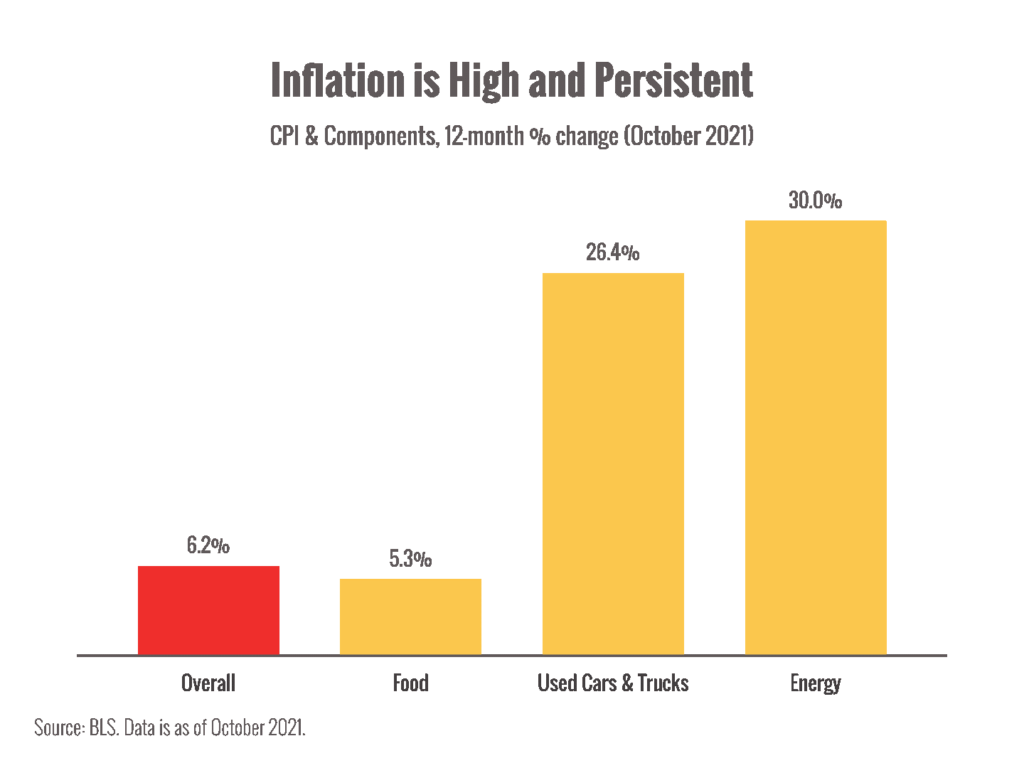
In the U.S., prices have increased 6.2% over the last 12 months — the biggest spike since November 1990
CPI & Components, 12-month % change (October 2021)

In the U.S., prices have increased 6.2% over the last 12 months — the biggest spike since November 1990. And you can see in the chart that some categories measured by the Consumer Price Index (CPI) have soared by much more.5

Since the Fed’s goal is to keep long-term inflation around 2% (and that’s what we’ve experienced this century), folks are concerned that “temporary” inflation is lingering longer than we want.

So, are prices going to continue to rise in 2022?

That’s likely, but how much, how fast, and for how long depend on a lot of global factors, including whether the Fed raises interest rates or takes other actions.

I’m keeping an eye on it.

Will your taxes go up in 2022?

That’s the question of the month on Capitol Hill as lawmakers debate the Build Back Better deal that could come with tax law changes.

We don’t know when (or if) the bill will be passed, but I’m watching closely and I’ll update you when we know what’s likely to happen.

Before I go, I’d like to wish you and yours a relaxing Thanksgiving with great food, great fun, and great memories.

Gratefully yours,

Goran Ognjenovic
Independent Investment Advisors
(971) 350-8068
www.independentadvisorsnw.com


P.S. It’s the time of year when the analysts start making predictions for 2022. What are your predictions for next year? What will be the big themes? Hit “reply” and let me know your thoughts!

1https://www.washingtonpost.com/us-policy/2021/11/09/biden-supply-chain-ports/

2 https://www.cnn.com/2021/11/09/politics/biden-infrastructure-bill-spending-economy/index.html

3https://www.moodysanalytics.com/-/media/article/2021/macroeconomic-consequences-of-the-infrastructure-investment-and-jobs-act-and-build-back-better-framework.pdf

4https://www.cnn.com/2021/11/13/economy/what-is-inflation-explainer/index.html

5https://www.bls.gov/news.release/cpi.nr0.htm

This information is not intended to be a substitute for specific individualized tax advice. We suggest that you discuss your specific situation with a qualified tax professional.

The following posts and commentary are to be used solely as educational tools and do not contain investment advice. Investment advice must be tailored to a particular investor’s specific needs. None of the information contained should be construed to be investment advice. Individuals wishing to tailor a plan to their own needs should seek the help of a Registered Investment Advisor.

There is a high degree of risk in investing and trading. Independent Investment Advisors assumes no responsibility. Principles of Independent Investment Advisors may, at times, maintain directly or indirectly, positions in securities or derivatives mentioned in these comments.

Gratitude practice?

Financial Planner · Nov 15, 2021 ·

< back to Market Insights Blog

The last few weeks and months have had a lot of stress and uncertainty.

So, instead of writing to you about politics, or the economy, or the supply chain, I figured I’d change the script and write about something completely different.

Let’s talk about gratitude.

Is gratitude a practice for you?

In my role as a financial professional, I’ll tell you that it should be.

Why?

Let's talk about gratitude!
Gratitude reminds you of what really matters.

Gratitude reminds you of what really matters.

Not the lines at the store.

Not the traffic.

Not what happens on Capitol Hill or Wall Street.

But, what really, truly matters.

I am deeply, abundantly grateful today.

For the food in my fridge.

For the roof over my head.

For my health.

For my circle of family and friends who love me.

For my community that has given me a home.

For my amazing clients and partners who have given me a vocation.

I’m grateful for you.

Taking inventory of all my blessings gets me through the minor irritations.

It also helps me reset when something major happens.

Gratitude calms me when things get stressful and overwhelming.

What are you grateful for?

Has it changed over these crazy couple of years?

Do you have any rituals around gratitude?

Please write back and let me know. I’m excited to hear from you.

With gratitude,

Goran Ognjenovic
Independent Investment Advisors
(971) 350-8068
www.independentadvisorsnw.com


P.S. Can I ask you to do something with me? Would you send an email or text to three people you are grateful for? I bet you’ll make their day. I wrote to you, so now I’ve just got two more :). Hit “reply” and share any responses you get.

P.P.S. Want some insight into the relationship between gratitude and happiness? Here’s a great TED talk on the topic by Benedictine monk David Steindl-Rast. If you watch it, will you send me your thoughts?

The following posts and commentary are to be used solely as educational tools and do not contain investment advice. Investment advice must be tailored to a particular investor’s specific needs. None of the information contained should be construed to be investment advice. Individuals wishing to tailor a plan to their own needs should seek the help of a Registered Investment Advisor.

There is a high degree of risk in investing and trading. Independent Investment Advisors assumes no responsibility. Principles of Independent Investment Advisors may, at times, maintain directly or indirectly, positions in securities or derivatives mentioned in these comments.

  • « Go to Previous Page
  • Page 1
  • Page 2
  • Page 3
  • Page 4
  • Page 5
  • Page 6
  • Go to Next Page »

Copyright © 2026 · Independent Investment Advisors · All Rights Reserved

  • Contact Us
  • Opt-out preferences
  • Disclaimer and Legal Notice
  • Privacy Policy
Independent Investment Advisors Logo
Manage Cookie Consent
To provide the best experiences, we use technologies like cookies to store and/or access device information. Consenting to these technologies will allow us to process data such as browsing behavior or unique IDs on this site. Not consenting or withdrawing consent, may adversely affect certain features and functions.
Functional Always active
The technical storage or access is strictly necessary for the legitimate purpose of enabling the use of a specific service explicitly requested by the subscriber or user, or for the sole purpose of carrying out the transmission of a communication over an electronic communications network.
Preferences
The technical storage or access is necessary for the legitimate purpose of storing preferences that are not requested by the subscriber or user.
Statistics
The technical storage or access that is used exclusively for statistical purposes. The technical storage or access that is used exclusively for anonymous statistical purposes. Without a subpoena, voluntary compliance on the part of your Internet Service Provider, or additional records from a third party, information stored or retrieved for this purpose alone cannot usually be used to identify you.
Marketing
The technical storage or access is required to create user profiles to send advertising, or to track the user on a website or across several websites for similar marketing purposes.
  • Manage options
  • Manage services
  • Manage {vendor_count} vendors
  • Read more about these purposes
View preferences
  • {title}
  • {title}
  • {title}